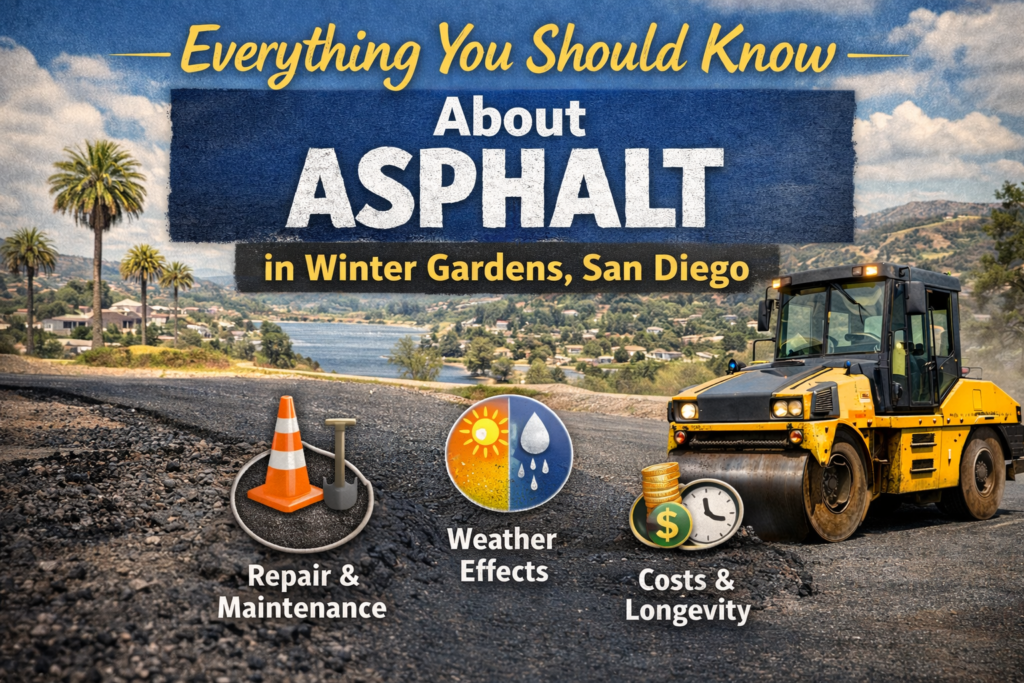
In communities like Winter Gardens, asphalt plays a quiet but essential role in everyday life. From residential driveways to commercial parking lots and access roads, it forms the surface people rely on daily often without thinking about how it works or what it needs to last.
Understanding Asphalt Contractor Winter Gardens at a fundamental level how it’s made, how it performs in Southern California conditions, and how it naturally ages gives property owners a clearer perspective on maintaining safe, durable surfaces over time.
What Asphalt Actually Is
Asphalt is a carefully engineered material made from a combination of aggregates such as crushed stone, sand, and gravel bound together by bitumen, a petroleum-based binder.
When heated and mixed, this material becomes workable and is applied in layers over a prepared base. Once compacted and cooled, it forms a smooth, durable surface capable of handling both light and heavy loads.
This combination of strength and flexibility is what makes asphalt one of the most widely used paving materials across the United States.
Why Asphalt Performs So Well in Winter Gardens
Southern California’s climate especially in inland areas like Winter Gardens creates a unique environment for pavement performance.
Unlike colder regions, there is little to no freeze-thaw cycle, which is one of the primary causes of pavement failure elsewhere. However, the region presents a different challenge: consistent sun exposure.
- UV radiation gradually oxidizes asphalt, causing it to lose flexibility
- The surface transitions from deep black to gray over time
- The material becomes more brittle, making it prone to cracking
At the same time, occasional seasonal rains introduce moisture into any existing cracks. Once water reaches the base layer beneath the asphalt, it can weaken the structure and lead to surface failures such as potholes.
This combination sun-driven oxidation and intermittent moisture is what defines asphalt aging in the Winter Gardens area.
How Asphalt Is Installed (In Simple Terms)
While the finished surface looks simple, asphalt paving is a multi-step process that depends heavily on preparation and precision.
- Ground Preparation
The soil is graded to ensure proper slope and drainage. - Base Layer Installation
A compacted aggregate base is installed to provide structural support. - Hot-Mix Asphalt Application
Asphalt is delivered at high temperatures and spread evenly across the surface. - Compaction
Heavy rollers compress the material to achieve density and strength. - Cooling and Curing
The surface hardens as it cools and becomes ready for use within 24–48 hours.
Each step directly influences how long the pavement will last and how well it performs under daily use.
Common Types of Asphalt Surfaces
In a community like Winter Gardens, asphalt is used across a wide range of applications:
- Residential driveways – Designed for light vehicle use
- Commercial parking lots – Built for higher traffic and heavier loads
- Private roads and access lanes – Often require stronger base support
- HOA and shared community surfaces – Balance durability with long-term maintenance planning
Each type of surface uses similar materials but may vary in thickness, mix design, and structural support depending on usage.
The Natural Lifecycle of Asphalt
Asphalt doesn’t fail suddenly it follows a predictable lifecycle.
Early Stage (0–5 years)
- Smooth, dark surface
- Structurally strong
- Minimal maintenance needed
Mid-Life (5–15 years)
- Visible fading due to oxidation
- Small cracks begin to appear
- Preventative maintenance becomes important
Later Stage (15+ years)
- Cracks widen and interconnect
- Surface wear becomes more noticeable
- Structural issues may begin if water has penetrated the base
Understanding this progression helps explain why early care has such a significant impact on long-term performance.
Why Asphalt Cracks and Deteriorates
Several factors contribute to asphalt deterioration over time:
1. Oxidation
Sun exposure breaks down the binder, reducing flexibility.
2. Water Intrusion
Water entering cracks weakens the base layer, leading to instability.
3. Traffic Load
Heavier vehicles accelerate wear, especially on thinner surfaces.
4. Poor Drainage
Standing water speeds up deterioration significantly.
5. Material Aging
All materials degrade over time especially those exposed to the elements daily.
These factors often work together rather than independently, which is why pavement issues tend to compound if left unaddressed.
Common Surface Issues You Might Notice
Recognizing early signs of wear helps prevent more serious problems later.
- Fading color – Indicates oxidation
- Hairline cracks – Early-stage surface stress
- Alligator cracking – Interconnected cracks signaling deeper issues
- Potholes – Result of water damage and base failure
- Raveling – Surface becoming rough as aggregates loosen
Each of these symptoms reflects a different stage in the pavement’s lifecycle.
The Role of Maintenance in Asphalt Longevity
Although asphalt is durable, it is not maintenance-free. Its longevity depends heavily on how well it is preserved over time.
Routine care focuses on:
- Protecting the surface from UV exposure
- Preventing water from entering cracks
- Preserving the integrity of the base layer
- Maintaining smoothness and safety
Regular maintenance doesn’t just improve appearance it directly impacts structural lifespan.
Environmental and Sustainability Considerations
One of asphalt’s lesser-known advantages is its recyclability.
Old asphalt surfaces are often milled, processed, and reused in new paving projects. This reduces waste and lowers the demand for new raw materials.
Additionally, innovations such as warm-mix asphalt and permeable pavement systems are helping reduce environmental impact and improve water management in urban areas.
Why Asphalt Remains the Standard Choice
Across San Diego County including Winter Gardens asphalt continues to be the preferred paving material for several reasons:
- It is flexible and adapts to ground movement
- It can be installed and repaired relatively quickly
- It provides a smooth, safe driving surface
- It is cost-effective over its lifecycle
- It is recyclable and adaptable to new technologies
These characteristics make it well-suited to both residential and commercial environments.
Final Thoughts
Asphalt may seem like a simple surface, but it is the result of careful engineering, environmental interaction, and ongoing maintenance.
For property owners in Winter Gardens, understanding how asphalt behaves especially under Southern California’s sun-heavy climate provides a practical advantage. It allows for better decisions, longer-lasting surfaces, and fewer unexpected issues over time.
Whether it’s a driveway, parking lot, or private road, the fundamentals remain the same: asphalt performs best when its lifecycle is understood and its natural aging process is respected.